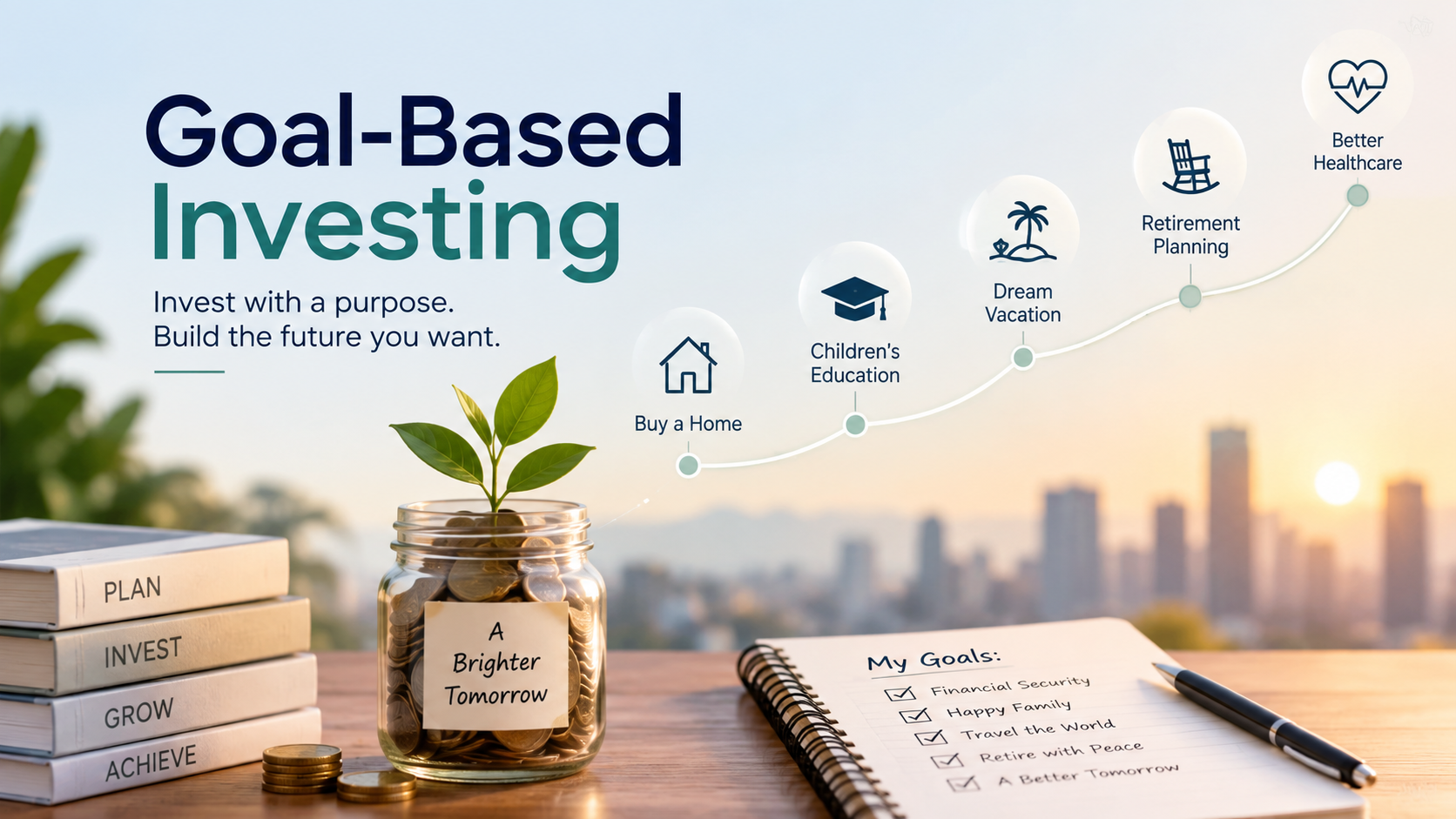
Introduction
Most people believe successful investing is all about earning the highest possible returns.
It isn't.
Imagine two investors. One earns impressive returns over the years but still struggles to arrange money for his child's education. The other earns relatively moderate returns but comfortably achieves every major financial milestone—from buying a home to retiring peacefully.
The difference isn't luck. It's planning.
Successful investing is not just about the size of your portfolio. It's based on how well your investments enable you to accomplish the things that are most important to you. Even with a growing portfolio, a lack of direction can leave you without a financial cushion when you need it most.
That's exactly what goal-based investment is designed to solve. It allows you to align each investment to a financial objective, rather than just hoping for higher returns.
In this blog, we'll understand how goal-based investment works, why it has become an essential part of modern financial planning, and how you can use it to build wealth that truly supports your future.
What Is Goal Based Investment?
Most of us start investing with one thought in mind—"I should start investing early."
So we begin a SIP, buy a few mutual funds, maybe invest in stocks whenever we have some extra money. It feels like we're doing the right thing.
But somewhere along the way, we forget to ask one simple question:
"What exactly am I investing for?"
That's where goal-based investment changes the conversation.
Instead of choosing an investment first, you begin with the goal. This could be anything like buying a home after 8 years, educating your kids, or even building up your retirement fund. Once you set a goal, it becomes a lot simpler to choose the right investment option.
In simple words, goal-based investment means investing in the right direction rather than simply making investments to make more profits. It's not all about the money but rather about the direction towards the desired life."
Goal-Based Investing vs Traditional Investing
While both goal-based investing and traditional investing aim to grow your wealth, the philosophy behind them is different.
The main goal of traditional investing is to be able to make more money and increase the value of your investments. Goal-based investing, however, starts with a goal and then works backward to create an investment strategy. In this instance, success is not just defined by returns, it's about whether you are on the right track to reach your financial goal.
The table below highlights the key differences between the two approaches.
Aspect | Goal-Based Investing | Traditional Investing |
Primary Focus | Achieving specific financial goals | Maximizing investment returns |
Starting Point | Begins with a financial goal | Begins with an investment opportunity or product |
Investment Strategy | Based on the goal, time horizon, and risk tolerance | Based mainly on return potential and market outlook |
Success is Measured By | Achieving the planned financial goal | Portfolio performance and returns |
Time Horizon | Determined by the goal's timeline | Often flexible or market-driven |
Risk Approach | Risk is managed according to the importance and timeline of the goal | Risk is generally taken to maximize returns |
Portfolio Management | Different portfolios can be created for different goals | A single portfolio may serve multiple objectives |
Investor Mindset | Purpose-driven and disciplined | Return-driven and performance-focused |
Types of Financial Goals
Not every financial goal should be planned in the same way. The amount of time you have to achieve a goal plays a crucial role in deciding where to invest, how much risk to take, and the returns you need to generate. Based on the time horizon, financial goals can be broadly classified into three categories.
1. Short-Term Financial Goals (Up to 3 Years)
These are the objectives you want to reach in the short-term and saving your money becomes more significant than earning high returns.
Examples include:
Building an emergency fund
Planning a vacation
Buying a laptop or other gadgets
Home renovation
Wedding expenses
2. Medium-Term Financial Goals (3–7 Years)
These objectives provide your investments with more time to grow and help you strike a balance between risk and return.
Examples include:
Buying a car
Saving for a home down payment
Starting a business
Funding higher education
Major home improvements
3. Long-Term Financial Goals (More Than 7 Years)
Long-term goals offer the benefit of time, because your money has the opportunity to grow through compounding and weather short-term market volatility.
Examples include:
Retirement planning
Children's higher education
Creating long-term wealth
Achieving financial independence
Leaving a financial legacy for your family
Every financial goal has a different destination and timeline. Understanding where your goal fits is the first step towards choosing an investment strategy that gives you the best chance of achieving it.
Also Read More-Top Banking, Finance & Economic Updates | July 2026
How Goal-Based Investment Works
1. Define Your Financial Goals
The first step is to determine what you want to accomplish. Your objectives may be to own a home, save for college, save for retirement, save for emergencies, or even dream vacations. The more clearly defined your goals, the easier it will be to plan your investments.
2. Estimate the Future Cost
The value of a goal today is not the same as it will be in 10 or 15 years. Inflation will gradually increase the price of almost everything, so it's important to be aware of the future value of your goal, not the present value.
3. Decide the Time Horizon
Every goal comes with a deadline. Whether your goal is three years or twenty years, it's important to know how you should go about it in order to make the best investment for your goals.
4. Assess Your Risk Tolerance
The investments you make should be based on your objective and risk tolerance. In general terms the longer the time frame for investments the greater risk one can take and shorter periods the more conservative investment approach would be.
5. Choose the Right Investment Mix
Once you have figured out your goals, time frame, and level of risk, choose assets that match all these criteria. Your goal will determine whether you will invest in equity, bonds, mutual funds, fixed deposits, or any other asset class.
6. Invest Regularly and Stay Consistent
In both Systematic Investment Plan (SIP) investment and lump-sum investment, consistency makes a difference in the long run. Avoid making decisions based on market ups and downs, and stay invested to stay on track.
7. Review and Rebalance Your Plan
Things don't always go the way you want. A change in your income, new duties or changing financial priorities can necessitate rethinking your investment strategy. Periodic portfolio reviews help to ensure that your portfolio remains aligned with your financial objectives.
How to Calculate the Amount You Need for Your Goal
Setting a financial goal is only the first step. To know whether you're on track, you will need to calculate how much money you will require, as well as how much you have to invest to meet this goal.
Let's understand this with an example.
“Suppose Neha wants to save for her daughter's higher education, which she expects will begin in 12 years. Here's how she plans her goal:”
Step 1: Define the Goal
Neha wants to save for her daughter's college education.
Step 2: Estimate the Future Cost
The course costs ₹20 lakh today. But, in general, education fees tend to rise with the passage of time, as a result of inflation. Assuming an annual inflation rate of 8%, the same course could cost around ₹50 lakh after 12 years.
Step 3: Decide the Investment Timeline
The time period of 12 years is long enough for Neha to build up her investment portfolio slowly and take advantage of long-term compounding.
Step 4: Review Existing Savings
She has already saved ₹5 lakhs for this goal. The remaining corpus is still a work in progress for her.
Step 5: Calculate the Required Investment
Based on the target amount, her current saving, expected returns and the investment horizon she has the Neha can estimate her monthly SIP contribution to achieve the goal. She can use an online SIP calculator or seek professional financial advice to arrive at an accurate investment amount.
Best Investment Options for Different Financial Goals
Financial Goal | Suitable Investment Options | Why They May Be Suitable |
Emergency Fund | Savings Account, Liquid Funds, Short-Term Fixed Deposits | Easy access to funds with relatively low risk. |
Child's Education | Equity Mutual Funds, Index Funds, Hybrid Funds | Suitable for long-term wealth creation while managing risk. |
Retirement Planning | Equity Mutual Funds, NPS, Index Funds, EPF | Helps build a long-term retirement corpus through disciplined investing. |
Wealth Creation | Equity Mutual Funds, Direct Equities, ETFs | Focuses on long-term capital appreciation. |
House Purchase | Hybrid Funds, Debt Funds, Fixed Deposits (depending on timeline) | Balances capital growth and stability based on when the funds are needed. |
Note: These are general investment options for educational purposes. The most suitable investment strategy depends on your financial goals, investment horizon, risk appetite, and overall financial situation.
Goal-Based Investment Example
Let's understand how goal-based investing works with a simple example.
Suppose Amit, a 32-year-old IT professional, has three important financial goals:
Buy a house in 7 years
Save for his daughter's higher education in 15 years
Build a retirement corpus by the age of 60
Amit does not invest all his money in one fund, rather he has investment plans for each goal.
For his house purchase, he invests with a medium-term strategy as he'll need the money within the next seven years.
In order to educate his daughter, he makes investments into the stock market, which allows him to give his funds sufficient time to mature.
He is aware of how to invest for the future, but does not feel like retiring at the moment, which is why he takes a long-term approach.
Amit always has a goal for each investment and knows how much he has saved for each goal, and if he has met it. He doesn't see success just in terms of portfolio returns; he sees success in his steps to each financial target.
It's all about goal-based investing: each investment has a purpose, every goal has a plan and every financial decision gets you one step closer to the goal.
Conclusion
Your investments need to grow—and they need to take you to your milestones. This is what goal-based investing is all about. Having a clear objective about money, picking investments according to your time horizon and reviewing your investment strategy often will enable you to make sound financial decisions and stay on course with meeting your financial objectives. Purposeful investing could bring you closer to achieving your financial objectives, whether you invest to purchase your dream house, pay for your kid’s tuition or accumulate wealth in the future.
Frequently Asked Questions
1. What is goal-based investment?
Goal-based investment is an investment approach where every investment is linked to a specific financial goal, such as buying a house, planning for retirement, or funding a child's education. It's not just about returns; it's about investing with a purpose and with a timeframe in mind.
2. Why is goal-based investing important?
Goal-based investing helps you connect your investments to your goals. It can help you plan systematically, select appropriate investments, control risk and monitor progress towards significant life goals.
3. How do I start goal-based investing?
Begin by establishing financial goals, determining the total amount you require, figuring out how long you would like to invest for, deciding how much risk you can tolerate, and selecting investments suitable for your goals.
4. What are the different types of financial goals?
There are three types of financial goals.
Short-term goals (up to 3 years)
Medium-term goals (3–7 years)
Long-term goals (more than 7 years)
The investments needed to achieve each goal are unique depending on the length of time and level of risk.
5. Which investment options are suitable for long-term financial goals?
Investors who are looking at long-term investments can even look at growth investment options such as equity mutual funds, index funds, exchange-traded funds, or investment programs for retirement. This will depend on your investment plans, the time horizon that you have in mind, and your risk.